

Bottom Line Up Front
This issue covers July 24-31, 2026, concentrated on digital infrastructure becoming an explicit instrument of geopolitical competition, spanning next-generation network standards, defense procurement, and sovereign AI capital.
Washington’s clearest move this week was diplomatic rather than commercial: the US rallied 24 governments behind a 6G security alliance aimed squarely at Chinese standards influence ahead of next year’s World Radiocommunication Conference in Shanghai. China’s state media dismissed it as a repeat of a failed 5G-era playbook, and an independent Western think tank reached a similar conclusion about US prospects for different reasons, citing fragmented federal coordination and slow financing tools. Both critiques deserve weight. Neither the alliance’s signatory count nor Beijing’s patent-filing statistics settle who actually wins the 6G contest; that will be decided by financing execution and standards-body votes, not press releases. MTN Consulting notes that Huawei’s position in the global telco supply chain is just as strong now as it was before the US imposed supply chain restrictions in 2019.
Underneath the standards fight, defense budgets are treating connectivity itself as a weapons platform. The UK committed £8 billion to a private 5G tactical network built explicitly around drone connectivity and jamming resistance, granting the contract to Ericsson in an important win for the telco-focused vendor. Germany’s Bundeswehr moved to open its weapons architecture so AI-enabled capability can be added by software update. The US closed its commercial market to new Chinese humanoid robots entirely, a broader step than the Pentagon procurement ban InfraVantage covered last week. Sovereign AI capital kept moving regardless of the standards fights: Korea tripled its planned AI factory capacity in a month, India’s Odisha state government co-financed a $1.6 billion sovereign AI data center, and CoreWeave’s move into classified US intelligence and defense cloud work shows neoscalers are no longer content serving hyperscaler overflow.
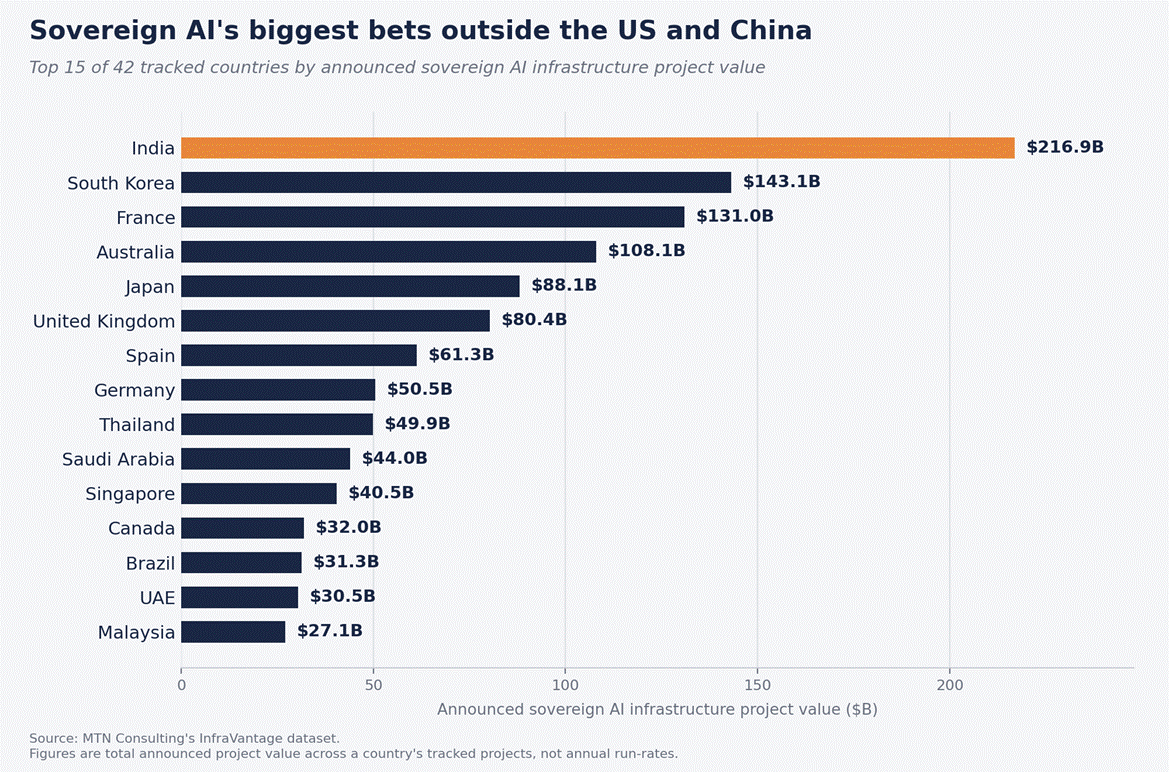
As a sign of the growing momentum behind Sovereign AI initiatives, the figure below summarizes the biggest commitments announced by country. This is extracted from InfraVantage’s Sovereign AI database tracker.
Signal vs. Noise
Below is a summary of recent developments at the intersection of AI infrastructure, national security, and geopolitics, our views on why they matter, and their implications for key players.
30-Jul-26
Leidos and CoreWeave to build sovereign AI cloud for US intelligence and defense missions
Leidos and CoreWeave announced a collaboration on 30 July 2026 to build secure, sovereign AI cloud services for the US Intelligence Community and Department of War. CoreWeave will supply its AI-native cloud platform, including GPU compute, storage, and orchestration, deployed inside Sensitive Compartmented Information Facility (SCIF)-accredited data centers. Leidos will lead mission integration, security accreditation, cyber operations, and data engineering. Planned capabilities include classified AI cloud services for model training and deployment, intelligence-analyst augmentation tools, cyber AI ranges for adversarial testing, synthetic data generation, and edge-to-cloud orchestration linking forward-deployed units to centralized compute. The collaboration builds on CoreWeave’s dedicated CoreWeave Federal business unit. No contract value has been disclosed.
Why it matters
CoreWeave completed its Nasdaq listing in March 2025 as a GPU-cloud pure-play serving hyperscaler overflow demand. This deal is a direct move into the defense and intelligence market that AWS GovCloud, Microsoft Azure Government, and Palantir have dominated for years. Winning a foothold inside SCIF-accredited infrastructure gives CoreWeave a credibility marker, which federal budget officers look for before awarding classified work. Leidos supplies what CoreWeave lacks: accreditation experience and standing relationships inside the US intelligence community and Department of Defense. The absence of a disclosed contract value or signed agreement is important. This is a positioning announcement ahead of appropriations decisions, not yet a revenue event. Neoscalers have learned that federal collaborations frequently take a year or more to convert into funded work.
29-Jul-26
UK selects Ericsson for £8 billion tactical 5G defense framework
The UK Ministry of Defence named Ericsson a direct supplier in its RM6393 Tactical Communication Systems framework on 29 July 2026. This is an eight-year, £8.03 billion ($10.8 billion) procurement program running to June 2034. Ericsson will supply private 5G Standalone infrastructure and integration services under Lots 1 and 3, alongside more than 70 approved suppliers including BT, Airbus, BAE Systems, and Finland’s KNL, part of Telenor Group. The framework underpins Project Morpheus, the UK’s program to replace its Bowman radio system with a network combining private 5G, satellite links, mesh architectures, and high-frequency radio. Planned use cases include reconnaissance drone video feeds, unmanned ground vehicle coordination, and AI-driven spectrum management built to keep units connected under jamming and cyberattack. Nokia does not appear on the published supplier list.
Why it matters
Britain just made private 5G the backbone of its next-generation battlefield network. By replacing the legacy Bowman radio system introduced in the early 2000s, Project Morpheus moves military tactical communications toward 3GPP-standard 5G Standalone (5G SA) architectures. This mirrors similar tactical 5G initiatives across NATO, such as Spain’s tactical 5G deployment at the Lešť base in Slovakia. This is an important win for Ericsson, as it struggles to find a position outside its core telco market. The new communications framework draws from over 70 suppliers, and is designed to pull in startups working on drone automation and signal encryption rather than routing everything through big legacy players like BAE Systems or Babcock. Nokia’s absence from the roster despite its mission-critical-network pedigree is notable. Ericsson has chosen to court defense ministries directly, while Nokia’s US and European defense engagements have so far leaned on federal-solutions subsidiaries and third-party integrators. That divergence is now visible in a live £8 billion contract. Rival vendors will be watching whether Ericsson’s direct model becomes a template to copy.
28-Jul-26
FCC adds foreign robots to Covered List, closing the US market to new Chinese humanoids
The US Federal Communications Commission voted on 28 July 2026 to add foreign-made “advanced robotic devices” to its Covered List, blocking new humanoid, quadruped, and connected mobile robot models from obtaining the authorization required for import and sale in the US. The FCC cited supply chain vulnerabilities and cybersecurity threats; previously authorized models are unaffected for now. Chinese firms accounted for more than 80% of humanoid robots installed globally in 2025, according to Counterpoint Research, making China’s robotics sector the primary target: Unitree, AgiBot, Geekplus, and Pudu Robotics all now face a closed US commercial market for new models. China’s foreign ministry spokesperson Mao Ning called the move protectionism that “will only harm American companies and consumers.” Tesla and other US developers stand to benefit.
Why it matters
This closes the loop we flagged in the 24 July issue on the National Defense Authorization Act’s Section 163: Congress banned only Pentagon procurement of Chinese-linked humanoid robots and explicitly left the FCC’s broader Covered List option on the table. The FCC has now taken that step, extending the block from military procurement to the entire US commercial market. AgiBot alone shipped its 15,000th unit in June 2026 and already runs a robot-rental business across five European markets; a closed US market removes its largest addressable buyer pool at the exact moment it was scaling exports. This should not come as a surprise to the Chinese developers, though, given the political climate. Tesla’s Optimus and other US humanoid programs gain a protected home market before they have matched Chinese unit economics or deployment volume. Whether that protection produces a competitive US humanoid industry or simply raises prices for US buyers with fewer choices remains untested. Either way, Elon Musk continues to benefit financially from his close ties to the ruling Republican party.
28-Jul-26
Bundeswehr moves to open architecture so AI can upgrade weapons by software update
Germany’s Bundeswehr will require open software architectures across all future weapons procurement so that arms can be upgraded via software update rather than hardware replacement, Lieutenant General Michael Vetter said in Berlin on 28 July 2026. The goal is to establish flexible platforms allowing third-party developers and startups to deploy new capabilities directly onto hardware. The Bundeswehr intends to use AI to process data feeds, accelerate target recognition, and shorten sensor-to-shooter decision loops. As an initial deployment, the “Uranus AI” project will aggregate reconnaissance data from unmanned systems along NATO’s eastern flank to support automated targeting and missile control.
Why it matters
