

Bottom Line Up Front
This issue covers July 31-August 7, 2026, concentrated on sovereign AI maturing across three tracks at once: new regulatory structures, direct earnings-call disclosure, and growing recognition that physical infrastructure is the exposed layer.
Two governments and one research center addressed sovereign AI directly this week. Germany’s Bundesnetzagentur became the country’s central AI Act enforcement authority on 29 July, folding AI oversight into the regulator that already runs telecom and energy networks. Japan’s CODAS launched Privacy-First AI infrastructure on 31 July, justified by a 6.85 trillion yen digital trade deficit rather than a security argument. CSET published a framework on 4 August that rejects the sovereign-versus-dependent binary, showing every country, including the US and China, mixing indigenous and foreign components.
Sovereign AI also stepped into the earnings spotlight. Seven companies used the term in Q2 2026 results between 27 July and 6 August, albeit with inconsistent definitions: Palantir and Alpha Compute mean enterprise data governance; Brookfield, F5, HIVE Digital, AMD, and Sharon AI mean national infrastructure sold directly to governments. Three signs of momentum: Brookfield’s France framework grew from EUR 20 billion to EUR 30 billion, F5 signed an EMEA telco for a sovereign AI factory, and HIVE Digital signed a $220 million GPU contract tied to Bell Canada.
The infrastructure underneath drew separate warnings. Chinese military researchers called submarine cables an easy target for drone attack. The FCC is drafting a ban on new Chinese optical transceivers inside US AI data centers. A House committee found Chinese telcos still hold data center footholds inside US networks despite years of license revocations. None of these has a clean fix: hardware can be banned or removed, but Chinese AI models now exceed 60% of routed inference traffic on OpenRouter, with no equivalent lever for reversing model adoption once it has scaled.
Signal vs. Noise
06-Aug-26
Shield AI and Taiwan’s NCSIST complete autonomous drone swarm exercise, part of a wider AI defense push which many view as combat-unproven
Shield AI and Taiwan’s National Chung-Shan Institute of Science and Technology (NCSIST) announced on 6 August 2026 the completion of a field demonstration in which three NCSIST-built Mighty Hornet III drones flew a coordinated, autonomous search mission using Shield AI’s Hivemind software. NCSIST engineers, working alongside embedded Shield AI staff, built and loaded the AI pilots onto the aircraft in under three months. The drones searched separate zones, respected a no-fly area, and landed autonomously. The exercise completes NCSIST’s original Hivemind integration contract, signed earlier in 2026, and triggers a contract expansion. That adds to Shield AI’s separate agreements with Taiwan’s Aerospace Industrial Development Corporation and Thunder Tiger Corporation. The demonstration is part of a broader AI defense buildout: Taiwan’s agencies plan to procure nearly 100,000 drones by 2027. On its National Day in 2025, Taiwan unveiled T-Dome, a proposed multilayered, AI-integrated air and missile defense system modeled on Israel’s Iron Dome.
Why it matters
Taiwan is building indigenous drone autonomy with a US vendor rather than buying a finished foreign system outright. Many NATO members take the same approach of building counter-drone systems with allied technology. For example, see the $40 billion NATO airspace-protection commitment we covered on 10 July. NCSIST’s ability to independently operate Hivemind after three months are key. Taiwan wants operational control of the software, not just the hardware, given how exposed a Taiwan conflict scenario would leave any system dependent on continuous US support. But Hivemind’s core selling point is resilience against jamming and GPS denial; that remains unproven against China, the adversary that matters. China’s People’s Liberation Army displayed integrated electronic warfare and cybersecurity capabilities at its September 2025 military parade, and has already tested electronic warfare attacks on a Dutch warship in the South China Sea in May 2026. No AI-piloted swarm has been tested in live combat against that capability. Taiwan’s own drone makers say they are not confident their systems can penetrate real Chinese jamming. Shield AI gains a foothold in a key market, but the testbed is still a demonstration, not a combat trial.
Sources: https://shield.ai/shield-ai-and-taiwans-ncsist-complete-autonomous-swarm-exercise-and-expand-sovereign-ai-and-autonomy-efforts/ | https://www.thinkchina.sg/politics/taiwans-proposed-ai-powered-t-dome-shield-combat-ready
06-Aug-26
Contractor sues Army, says AI hallucination cost it a $450 million contract
Trax International filed suit in the US Court of Federal Claims in late July 2026, asking a judge to force the Army to re-evaluate bids for mission support services at White Sands Missile Range. Trax alleges the Army used artificial intelligence that hallucinated during evaluation, wrongly making Trax’s bid look weaker than the winning $450 million bid from Southwest Range Services. The Government Accountability Office denied Trax’s prior bid protest in May. The lawsuit states the Army could not confirm whether a cited weakness in Trax’s proposal came from a human evaluator or an AI tool, and that the weakness contains fabricated references to Trax’s proposal that nobody checked. The Army declined to comment on the pending litigation.
Why it matters
This is the second public allegation this year that a defense agency used AI to evaluate bids without disclosing it, after a similar claim against a different Department of Defense subagency was dismissed by the Government Accountability Office in January. Neither the Pentagon’s AI-first procurement mandate nor federal disclosure rules currently require agencies to flag AI use in high-impact evaluations, and few report it even when they use it. That gap leaves contractors proving a negative: that an unstated evaluation method produced fabricated findings. The pattern points to acquisition offices bolting AI onto existing evaluation workflows faster than accountability rules can catch up. This mismatch will generate more protests and lawsuits before it generates policy.
Source: https://www.defenseone.com/policy/2026/08/ai-army-contract-lawsuit/415261/
06-Aug-26
“Sovereign AI” becomes a Q2 earnings-call fixture, but companies mean different things by it
Recent tech filings are putting Sovereign AI in the spotlight.
Palantir’s Q2 2026 call on 3 August, alongside 93% year-over-year revenue growth, had CEO Alex Karp frame “AI sovereignty” as enterprises “owning the operational definition of the data, logic, actions and security of their enterprise.” AMD’s Q2 2026 call on 4 August said its MI350 Series adoption broadened across “the largest AI labs, cloud providers, leading AI start-ups, national labs and the sovereign AI deployment.” Brookfield Asset Management’s Q2 2026 call on 5 August disclosed it had expanded its sovereign AI development framework with France from EUR 20 billion to EUR 30 billion and partnered with Naver and NVIDIA on South Korea’s national AI factory buildout. F5’s fiscal Q3 2026 call on 27 July said a Q3 win came from an EMEA service provider that selected F5 “to power its sovereign AI factory,” and described its “sovereign AI customers” as cost-conscious telcos outside the US building AI factories.
HIVE Digital Technologies disclosed via 8-K on 18 June a $220 million sovereign AI GPU contract between its Buzz HPC subsidiary, Bell AI Fabric, and Cohere. Sharon AI, an Australian neocloud, announced a new CFO in August, saying the appointment “comes at a pivotal stage in Sharon AI’s growth as the company continues to scale its AI cloud platform and expand its position as a provider of sovereign AI infrastructure…”. Alpha Compute Corp told investors on its 16 July call that its qualified pipeline “across AI research labs, sovereign entities and enterprise customers” exceeds $200 million.
Why it matters
Seven companies using the same two words in the same window does not mean seven companies describing the same thing. Palantir and Alpha Compute use sovereign AI to mean a company’s control over its own data and models. F5, HIVE Digital, Brookfield, AMD, and Sharon AI use it closer to the term’s original sense: telcos, neoclouds, and infrastructure funds building AI compute capacity that a national government owns, funds, or contracts for directly. Investors tracking the phrase without distinguishing the two meanings will overstate how much genuine government-directed compute demand actually exists. True Sovereign AI, though, is nonetheless real and growing, and it is the more consequential of the two: Brookfield’s EUR 30 billion France framework and Korea partnership, F5’s EMEA telco win, and HIVE’s Bell Canada contract all involve government-linked counterparties with signed dollar figures attached. Sovereign AI is maturing fast enough to show up as a distinct, quantified revenue line on earnings calls. Company-level sovereign AI claims should be assessed case by case rather than treated as a single trend line.
Sources: https://www.sec.gov/Archives/edgar/data/1937926/000117184326004879/0001171843-26-004879-index.htm | https://www.sec.gov/Archives/edgar/data/1720424/000106299326003293/0001062993-26-003293-index.htm | https://www.sec.gov/Archives/edgar/data/2068385/000149315226036254/0001493152-26-036254-index.htm | https://www.bamsec.com/transcripts/feef5444-af4a-4465-918a-bdc350126911 | https://www.bamsec.com/transcripts/e2b4067e-12a7-4f51-b698-16b749d70ea6 | https://www.bamsec.com/transcripts/07da065a-998b-4970-8640-eb91e3ff94fd | https://www.bamsec.com/transcripts/67cb50ad-c26f-4175-90cf-b1013da9a0b8
05-Aug-26
House committee: Chinese telcos still embedded in US networks despite Salt Typhoon links
The House Select Committee on China published a 49-page investigation on 5 August 2026 into China Mobile, China Unicom, and China Telecom, three companies that lost or had their US telecommunications licenses revoked between 2019 and 2022 over security concerns. The committee subpoenaed all three, interviewed company staff in September 2025, and found that Federal Communications Commission license actions limited but did not remove the companies’ presence in US infrastructure. Each firm sits at the bottom of an ownership chain running through Hong Kong holding companies to a Chinese state-owned enterprise. After losing their licenses, the companies moved into less-regulated network services, retaining hardware, interconnection agreements, and data center space the committee calls “trusted” backdoors. The report ties the companies to prior internet-routing incidents and links China Unicom and China Mobile to firms already sanctioned over the Salt Typhoon hacking campaign.
Why it matters
This is an embarrassment for the US. Congress spent years revoking these companies’ licenses but still left them holding data center footholds, interconnection agreements, and Chinese-made equipment inside US networks. That says more about the limits of US telecom regulation than about Chinese intent. The same week, a separate development shows why this gap matters beyond telecom cores: Chinese AI models now account for more than 60% of routed inference traffic on OpenRouter, up from under 2% eighteen months earlier (OpenRouter usage data reported 29 July 2026). The US has no equivalent mechanism to rip and replace a dominant AI model the way it can order hardware removed from a network, because model usage is a commercial choice made by thousands of individual companies chasing lower inference costs, not a licensed telecom service. If Chinese hardware proved this hard to fully extract from regulated network infrastructure, extracting Chinese models from unregulated enterprise AI stacks will be harder still.
Source: https://therecord.media/chinese-hackers-telecoms-house
05-Aug-26
Chinese military researchers call submarine cables an “easy target” for drone attack
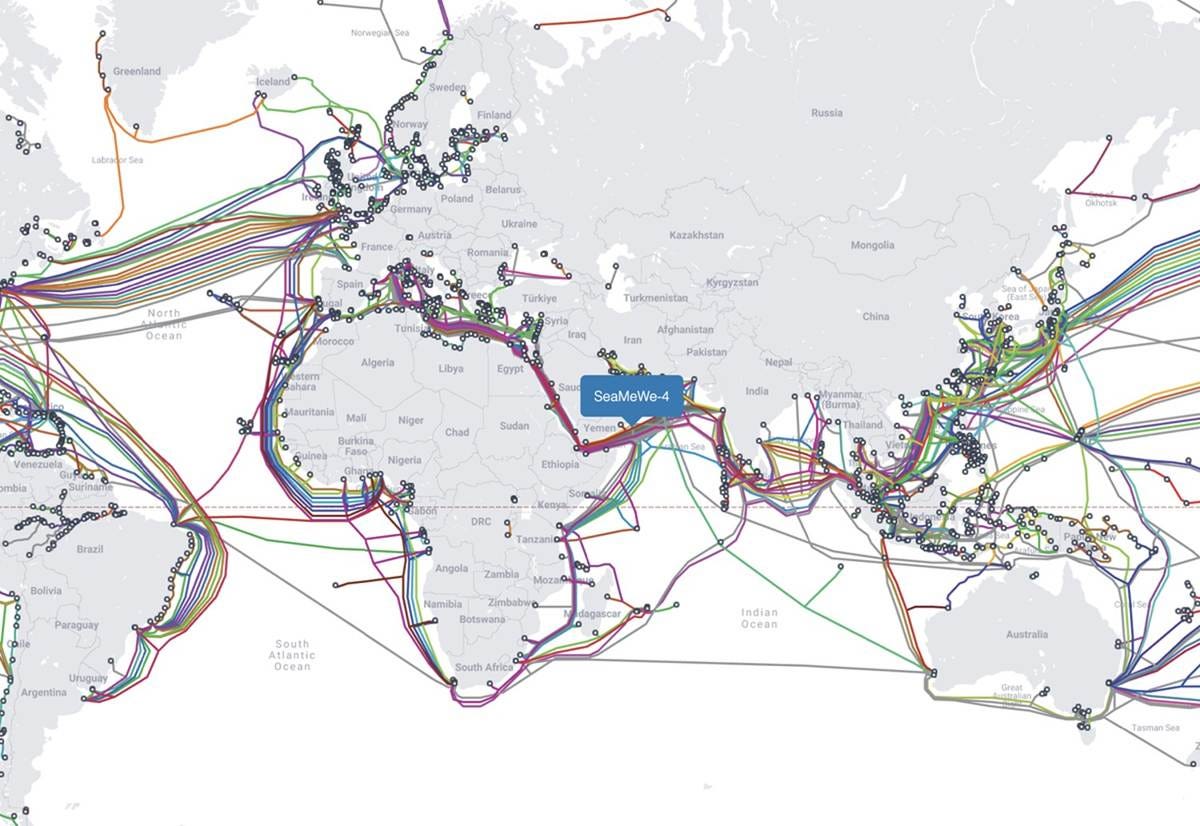
China’s National Defence University researchers Shi Guanglei and Shi Haiming wrote in the state-run Science and Technology Daily that undersea cables carrying 99% of intercontinental data traffic have become an increasingly easy target for low-cost uncrewed underwater vehicles, in comments carried in English on 5 August 2026. They argue that the barrier to entry for undersea warfare is falling because small drones let countries without expensive crewed submarines contest the seabed, and specifically cite the Aukus submarine pact among Australia, Britain, and the United States as accelerating this shift. The researchers point to the 2022 Nord Stream pipeline sabotage and the 2024 cutting of Red Sea cables as precedents, and estimate that cables underpin roughly $10 trillion in daily cross-border transactions.
Why it matters
This article is not really about Aukus. It is a justification memo for a capability China is already using. Blaming Aukus submarines for lowering the barrier to undersea warfare lets Beijing frame future cable damage as a response to Western provocation rather than a deliberate first move. China does not need the drone capability these researchers describe: it is already cutting cables with commercial vessels and attempts to maintain plausible deniability. Taiwan has logged five suspected cable-sabotage incidents this year, versus three each in 2023 and 2024, including the Hong Tai 58 crew convicted in 2026 for deliberately dragging anchor through a marked cable zone near Penghu, and the Shunxin 39, which severed a Taipei-area cable in January 2025 while owned by a Hong Kong-registered shell company. In a sense, China is building a public, academic rationale for a tactic its own vessels have already normalized using low-cost, deniable methods. It is not discussing a hypothetical future threat requiring new drone technology. Washington’s response so far is limited to hardening its own chokepoints rather than raising the cost of an attack that has already happened five times this year.
04-Aug-26
CSET publishes a two-pronged framework for assessing sovereign AI
The Center for Security and Emerging Technology (CSET) at Georgetown published a report on 4 August 2026 proposing a framework for assessing sovereign AI. The framework is based on why states pursue it (national interest, technological sovereignty, or soft power) and how they build it across the AI stack’s hardware and software layers. The report profiles five countries. Per CSET, the United States pursues a full-stack export strategy built on OpenAI, Anthropic, Google DeepMind, Nvidia, and the major cloud platforms. China integrates state-backed models, domestic chips, and cloud infrastructure, and is exporting that stack to Malaysia, the UAE, Saudi Arabia, and Kenya through firms like Zhipu AI. India pursues a hybrid strategy, building domestic language models while depending on US chips and cloud infrastructure. Singapore relies on both US and Chinese technology while building regional models. France pursues what the report calls a “third way,” investing in Mistral AI and domestic chip design while still relying on Nvidia and AMD hardware. The report cites Epoch AI data showing the US controls 75% of global AI compute and China 15%.
Why it matters
The report’s most useful contribution is reminding us that sovereignty in AI is not a black or white question, but about shades of gray. Every country in the five case studies, including the US and China, mixes indigenous and foreign components at different layers of the stack. That framing matters directly for this issue’s other sovereign AI items: Germany standing up its own AI Act enforcement body, Japan launching a data-sovereignty consortium, and Brookfield selling compute directly to national governments are all partial-sovereignty moves in this framework’s terms. The report also understates how commercially driven partial dependence actually is. France’s Mistral, held up here as a sovereignty case study, spent the same window signing a multi-billion-dollar infrastructure deal with Microsoft, the exact kind of US hyperscaler dependence the third way is supposed to reduce.
Source: https://cset.georgetown.edu/article/assessing-sovereign-ai-a-two-pronged-framework/
04-Aug-26
Reuters: Trump administration drafting ban on Chinese AI data center components
The Federal Communications Commission is drafting a ban on US imports of new Chinese-made optical transceivers used inside AI data centers, four sources told Reuters in an exclusive report published 4 August 2026. Transceivers move data across fiber-optic cables inside data centers at the speed of light. Officials want the rule published and in effect this year. The measure targets new models only and would not affect transceivers already installed. China’s Zhongji Innolight, which holds roughly 27% of the global transceiver market and generates 90% of its revenue outside China, would be among the hardest-hit suppliers; the company was added to the Pentagon’s list of alleged Chinese military-linked companies in June. Shares of Lumentum, Coherent, and Applied Optoelectronics, seen as beneficiaries, rose 7%, 11%, and 18% respectively after the report. The Chinese embassy in Washington said Beijing would respond if the measure causes material harm to its interests.
