

When people talk about chokepoints in tech, usually they mean manufactured components with high barriers to entry. GPU semiconductors. Or optical transceivers. Or lithography machines. Chokepoints can also come from networks. That could be a transport network, such as the Strait of Hormuz. It could also be the electrical network. It turns out that Southeast Asia’s AI prospects rest heavily on cross-border electricity supply from Laos.
On 14 January 2026, electricity companies from four countries signed an important agreement. Specifically, Malaysia’s TNB, Thailand’s EGAT, Singapore’s Keppel Electric, and Électricité du Laos signed Phase 2 of the Energy Wheeling Agreement (Malay Mail, 14 January 2026). The agreement commits a minimum of 30MW of Lao hydropower transmitted across Thailand and Malaysia to Singapore (Malay Mail, 14 January 2026). That’s just a start.
Singapore’s Energy Market Authority plans to import approximately 6GW (6,000MW) of low-carbon electricity by 2035, representing one-third of projected national demand (EMA, Regional Power Grids). Singapore is matching data center expansion timelines with electricity import commitments. Initial supply is originating from Laos.
In total, projects from Laos hold 5,941MW of operational contracted export capacity to Thailand, across nine projects (Lao Ministry of Energy and Mines, 2023 data, presented December 2024). That works out to 11.4% (approximately one-ninth) of Thailand’s current installed capacity of 52GW (US Commercial Service, April 2025 data). Cambodia is the fourth buyer, taking 445MW under contract, chiefly from the Don Sahong dam on the mainstream Mekong. Vietnam holds 2,379MW of operational contracted Lao capacity and has approved 47 additional Lao projects totaling over 8,260MW, targeting 5,000MW in imports by 2030. In the first quarter of 2026, Lao power supplied 3.8% of Vietnam’s electricity output during a seasonal high (Vietnam Electricity, via Laotian Times, 27 April 2026).
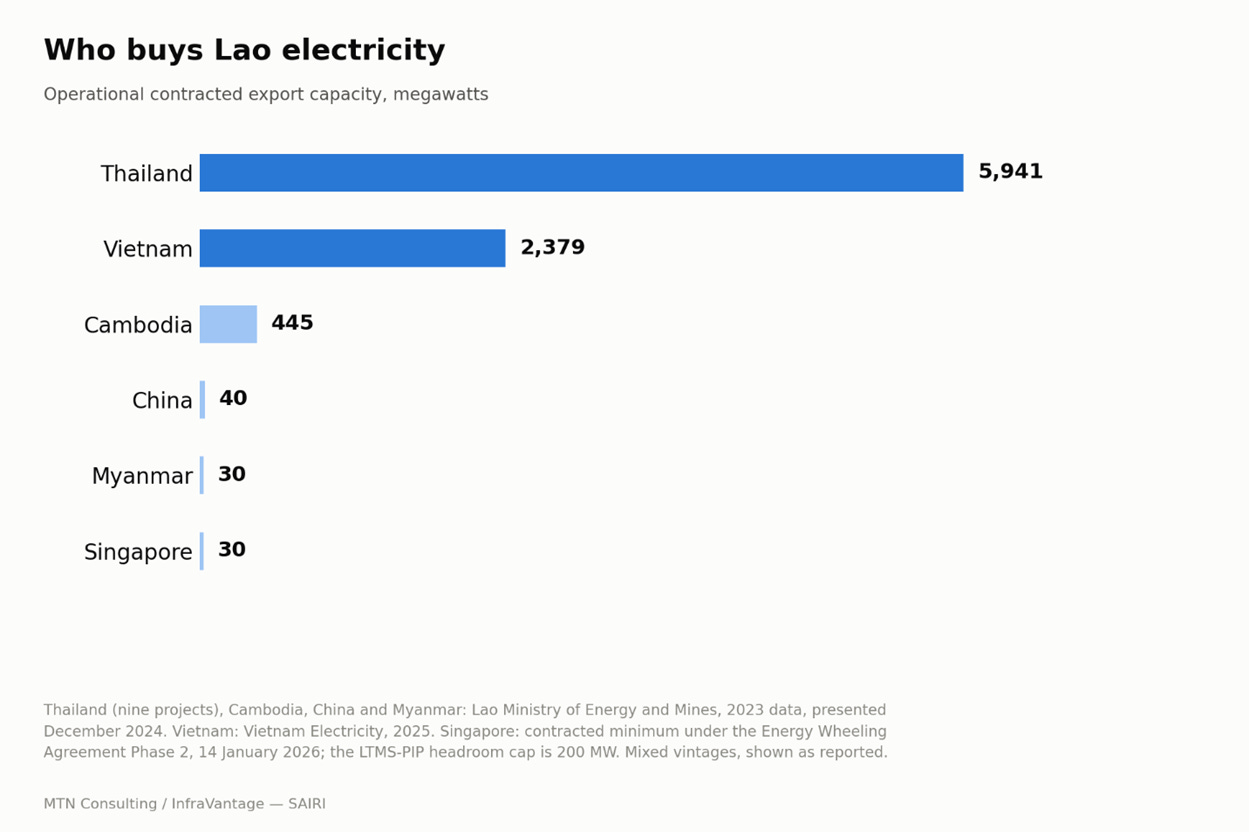
Four nations are planning AI compute capacity while relying on a single upstream power exporter.
Laos power transmission and debt structure
Building power plants and transmission networks for power can be very costly, so is a frequent target of foreign investment – both from the private sector and via foreign aid programs. That’s true for Laos. Both Chinese and Thai companies have invested heavily in the sector over the years. Some of the Chinese investment has been through the belt and road initiative (BRI), as Laos is an active participant. Of the 39 loans to Laos tracked by AidData’s BRI tracker, 24 of them were in the energy sector. There is a lot of Chinese investment outside of the BRI as well. In aggregate, Chinese entities hold around 40% ownership stake in the Lao power sector. Thai companies are also significant, especially EGAT, the state utility that buys most of the exported power. As for generation capacity, the most recent data available suggest that China held 8,063MW of sponsored capacity in Laos, compared to Thailand’s 12,984MW (Stimson Center).
While China is not the majority stakeholder in the sector, it has outsized influence that matters for geopolitics and AI. Most important is its control over electric transmission, but debt concentration is becoming a point of leverage too:
Transmission Infrastructure: China Southern Power Grid owns 90% of Électricité du Laos Transmission Company. The company holds a 25-year concession over the Lao transmission network above 230kV, including cross-border interconnections. The concession was signed on 11 March 2021, and operations began on 29 January 2024 (AidData; Lowy Institute, 13 April 2025). Electricity exported to Thailand, Vietnam, and Singapore moves across infrastructure operated by a Chinese state-owned enterprise.
Sovereign Debt: Laos has been in debt distress for several years, in part due to the burden of Chinese loans. Principal payments on debt have been postponed every year since 2020; the figure that was postponed in 2024 works out to nearly 3% of national GDP, so it’s a big burden (World Bank, January 2026).
This creates some strange incentives. Even if China doesn’t own most of Lao power generation, it controls the wires. Now neighboring countries will rely more on Lao power for AI data centers, to power an activity that most policymakers now argue is key to economic growth. So, China can exert control over Singapore, for instance, via Laos. This is not far-fetched conspiracy theory mongering – it’s how the world often works.
What Laos does when there isn’t enough power
Laos has already had to choose between serving compute load at home and honoring its export contracts. That was only three years ago, and compute lost.
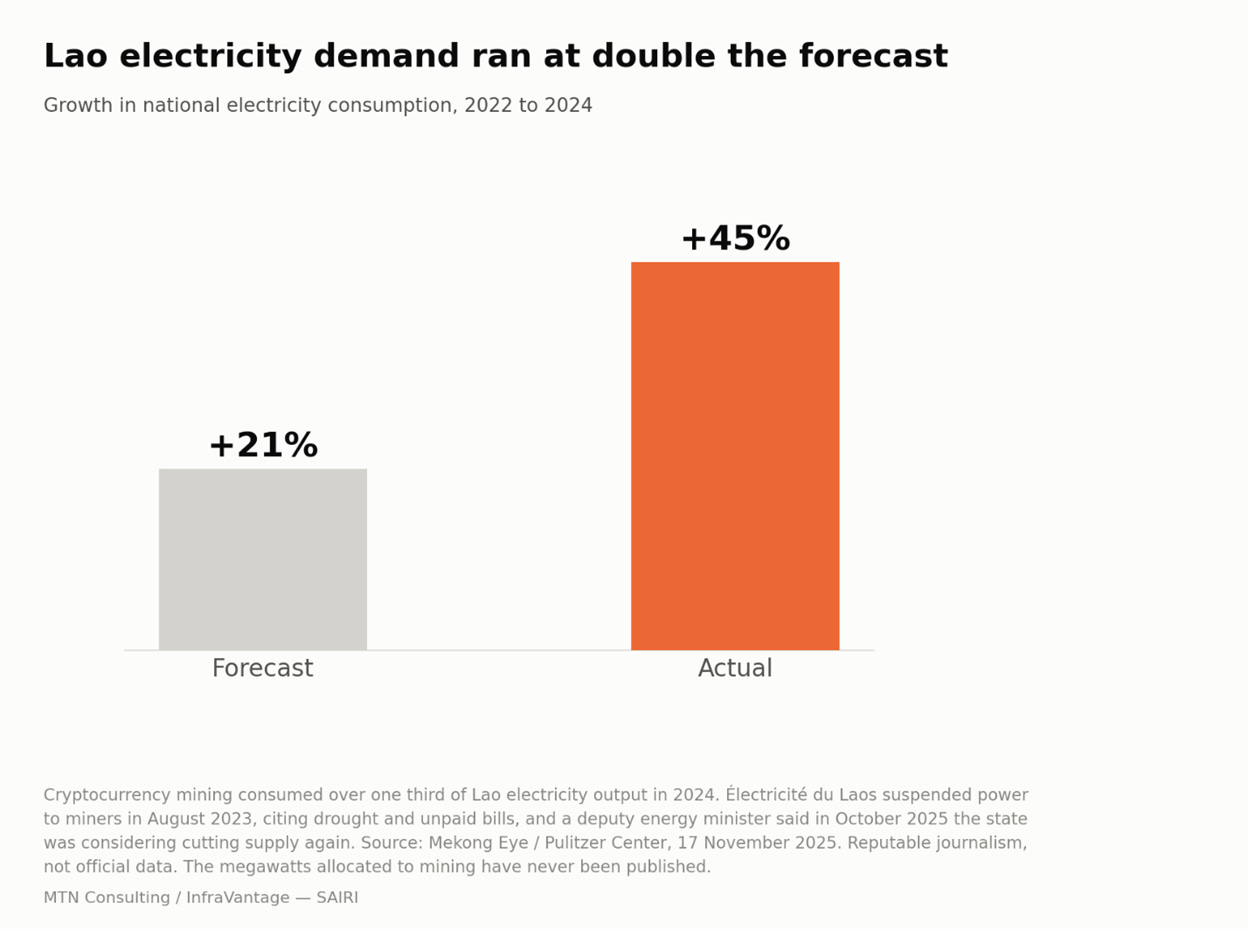
In late 2021 the government issued fifteen cryptocurrency mining licenses and started selling power to the miners. By 2024, mining was consuming more than a third of total Lao electricity output. National consumption grew 45% between 2022 and 2024, against a forecast of 21%. The grid could not support demand from both the miners and export contracts at the same time. Électricité du Laos suspended supply to the miners in August 2023, citing drought and unpaid bills. By October 2025 the Ministry of Energy and Mines was weighing further cuts to mining allocations.
So what does the episode actually tell us?
The first is that compute demand can be incredibly volatile and unpredictable, especially in a small market like Laos. Lao national consumption grew more than twice as fast as the forecast in the space of two years, and cryptocurrency mining accounted for a large share of the gap. Any country hosting compute should assume its own demand forecast is wrong on the low side.
