

Much of the AI world is talking about China’s latest entrant in the model wars. Last week, Beijing-based Moonshot AI launched Kimi K3, the world’s largest open-source AI model (for now). Moonshot claims Kimi K3 outperforms Anthropic and OpenAI on some criteria, and it is getting rave reviews. The New York Times’ headline summed up sentiment to date: “China’s Latest A.I. Breakthrough Threatens America’s Lead.”
But China doesn’t need to win the frontier model race to win the race that matters more: becoming the default AI vendor for the 150+ countries that will never train a frontier model of their own. That contest runs through infrastructure relationships China has built for over a decade; AI is just the newest layer on top.
The instability of Washington’s own export-control regime is helping the case along. On June 12, 2026, the US Commerce Department blocked Anthropic from supplying its most capable public models to any foreign national, forcing a worldwide shutoff of Claude Fable 5 and Mythos 5 that lasted until access was restored on July 1. This followed 18 months of see-sawing restrictions and threats aimed at China. Every reversal like this is a data point for the argument, made below, that the US struggles to hold a policy in place, and China’s financing model does not have that problem.
The frontier model race is not the only race
Coverage of US-China AI competition mostly asks who builds the best model. China is positioned to win the other race regardless of who leads on frontier capability, because relationships decide default-vendor status, not benchmark scores. China has invested in relationship-building since Xi Jinping proposed the Belt and Road Initiative in Kazakhstan in September 2013. The BRI built China’s earlier influence on ports, railways, and power plants, and it is now extending the same financing model to chips, memory, networking gear, power systems, and language models. The Digital Silk Road, the initiative’s digital component announced in 2015, has moved slowly from hard infrastructure toward AI governance diplomacy and service-layer platforms over the last five years. This is not a sudden turn. It is the same relationships being leveraged in a new product category.
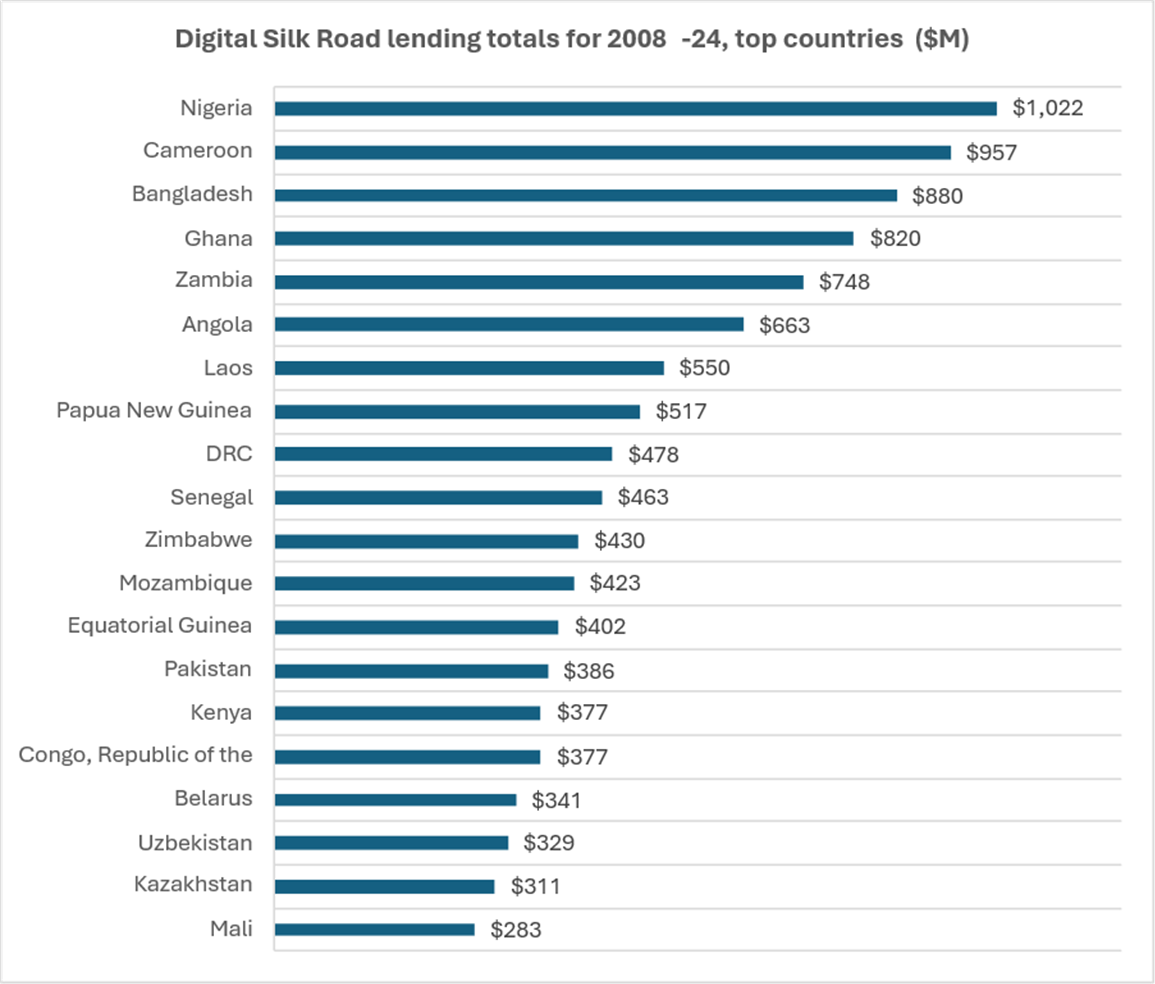
The Digital Silk Road is a relatively small component of the overall BRI project, accounting for just 3% of total funding on average. But even small DSR loans can be used strategically to embed China’s tech ecosystem into a government’s supply chain. The figure below illustrates some of DSR’s key recipient countries over the years.
Software: Qwen leads, DeepSeek diffuses, and Zhipu just proved something about chips
Alibaba’s Qwen family passed one billion cumulative Hugging Face downloads by March 2026 and took more than half of global open-weight downloads that month, per Hugging Face download data. Microsoft’s own usage data shows DeepSeek adoption in Africa running two to four times higher than in other regions. Open weights matter here because they let local developers fine-tune for local languages without depending on API pricing set in San Francisco. In Indonesia, AI venture AIonOS has partnered with Indosat Ooredoo Hutchison to build DeepSeek-powered tools for tourism, agriculture, and the knowledge economy, already live commercially.
The bigger story last month was Zhipu AI, trading as “Knowledge Atlas Technology JSC Ltd” (HKEX: 2513). On June 13, 2026, one day after Washington’s Anthropic order, Zhipu released GLM-5.2 under a permissive MIT license with no regional restrictions Zhipu’s Hong Kong-listed market value crossed HK$1 trillion, about $128 billion, on June 22, 2026, as GLM-5.2 drove a 42 percent single-day share surge. Zhipu says GLM-5.2 was trained entirely on roughly 100,000 Huawei Ascend 910B processors, using Huawei’s MindSpore framework, with no Nvidia hardware at any stage. That claim is unverified outside Zhipu and Huawei, but if accurate it is the first public evidence Ascend chips can train a competitive model at scale. The Ascend 910C’s inference performance reportedly sits at roughly 60 percent of an Nvidia H100.
Moonshot AI raised the bar again on July 16, 2026, releasing Kimi K3, a 2.8-trillion-parameter model that Artificial Analysis ranks fourth among all frontier models, behind only Anthropic’s Claude Fable 5 and OpenAI’s GPT-5.6 Sol, and ahead of Claude Opus 4.8, per Bloomberg. Moonshot calls it the largest open-weight model released to date, though the weights themselves are not due until July 27, 2026; for now K3 is available only through Moonshot’s API. Unlike Zhipu’s all-Ascend claim for GLM-5.2, Moonshot’s own technical disclosures for K3 point to Nvidia’s export-grade H200 chips and an unnamed “alternative vendor” GPU. That’s a reminder that China’s frontier labs are not moving in lockstep toward domestic silicon. The bigger surprise is the price: at $3 per million input tokens and $15 per million output, K3 costs roughly what Anthropic charges for its Sonnet tier. That’s a break from the deep discounting that defined Moonshot’s own K2.6 and models like DeepSeek. For the first time, a leading Chinese lab is competing on capability rather than undercutting on cost.
China has penetrated and come to dominate global markets before by “buying” market share early with aggressive pricing, sometimes state-subsidized and sometimes not. Open-weight LLMs follow the same pattern. Chinese labs mostly lose money on the open weights themselves, but they can recover the cost through cloud consumption and enterprise services once a government or company has standardized on the model. A loss leader can become a market leading default option in price-sensitive markets. And we are not talking about shoddy products; China’s LLMs are ranked among the world’s best, and prices are very competitive. Kimi K3 complicates this pricing story. Moonshot priced it near Western rates rather than undercutting, betting that capability alone can win adopters once the open weights ship on July 27. Whether that bet pays off is worth watching.
The loss-leader dynamic described above is not limited to developing countries. It works on any buyer that is price-sensitive, and EU public-sector agencies operating under fixed budgets qualify as price-sensitive buyers too.
Chips: Real at home, still mostly a pitch abroad
China is not yet pushing chips into Belt and Road markets, but domestically the numbers are large. Huawei aims to sell roughly 600,000 Ascend 910C chips in 2026. More recent reporting has the newer Ascend 950PR entering mass production in the first quarter of 2026, with ByteDance alone reportedly committing over $5.6 billion to Ascend chip purchases this year. With Alibaba and Tencent, public commitments already exceed 750,000 units for 2026, more than Huawei’s own goal, driven by necessity since Nvidia’s top chips became hard to secure after October 2022 controls (same source).
