

Trade talks between Washington and Ottawa collapsed on 22 August 2026. Fifty percent US tariffs took effect right away on roughly $20 billion of Canadian goods. Canada answered with counter-tariffs on $27.6 billion, to take effect on 8 September. Canadian Prime Minister Mark Carney pulled his negotiators out the same day and said on 23 August that Canada was “under attack”. The next day, Trump replied that Canada “will be treated like a [sovereign] State no longer”, and added that “we don’t need Canada, they need us” while threatening 50% tariffs on Canadian vehicles, parts and steel starting 1 January 2027. This is the second round of the same play: tariffs applied as pressure to force a deal. What is new is what Trump is asking for. Washington wanted a right of first refusal over Canada’s critical minerals. This has direct relevance to the global AI buildout being driven by hyperscalers.
The politics behind the demand
Trump picking a fight with a weaker – or simply less boisterous – party in order to extract concessions is nothing new. It’s also not unique to Trump. This pattern is familiar enough that the trade demand may have as much to do with domestic politics as with minerals. Selectorate theory, set out by Bruce Bueno de Mesquita, Alastair Smith, Randolph Siverson and James Morrow in The Logic of Political Survival (MIT Press, 2003) and summarized in this overview of the theory, holds that leaders act first to hold the coalition that keeps them in office. In Trump’s case, that coalition falls under the “MAGA” term. A visible fight with a neighbor pays that coalition whether or not it produces a deal. In other words, Trump’s fight with Canada is entirely predictable, if you consider both domestic US politics and the relative power of the two countries over certain chokepoints. This is important because being able to predict the outcome of international disputes has tangible economic value.
What a gigawatt of nuclear energy costs in uranium
A hyperscaler signing up for a gigawatt of nuclear capacity is in effect committing to about 548,950 pounds of uranium a year, even if the contract doesn’t say as much. Meta’s existing-plant agreements alone imply roughly 1.8 million pounds a year, about 4% of everything US utilities bought in 2025. Canada supplied 32% of that pool at the mine, and it owns the two processing steps every pound passes through next.
Canada is not the weaker party in this dispute. The United States cannot reach its nuclear energy targets without Canadian uranium, and it is trying to tariff Canada into a trade deal at the same time. This post sets out the evidence for that, and what it means for the companies building AI data centers.
What 400 GW would actually need
Consider US policy on energy development. Four executive orders signed in May 2025 set a target of moving US nuclear capacity from about 100 GW to 400 GW by 2050, 4 times today’s fleet, with ten large reactors with complete designs under construction by 2030. On data centers the orders are vaguer than the headlines suggested: the Department of Energy is to lay the groundwork for building and operating an advanced reactor supporting AI or other critical infrastructure no later than October 2027.
What kind of fuel would that take? Every power reactor in the world today adds up to about 400 GW of generating capacity, and that whole fleet burns roughly 67,000 tonnes of uranium a year, per the World Nuclear Association. The 2050 target would put a fleet that size inside one country. Fueling it would take about 174 million pounds of U3O8 a year, 3.7 times what US utilities bought in 2025. That assumes light water reactors, which is the current US preferred design. Advanced designs use uranium at different rates, and we will discuss this in the last section below. What no design changes is the mining, refining and conversion that has to happen before any uranium reaches an enrichment plant.
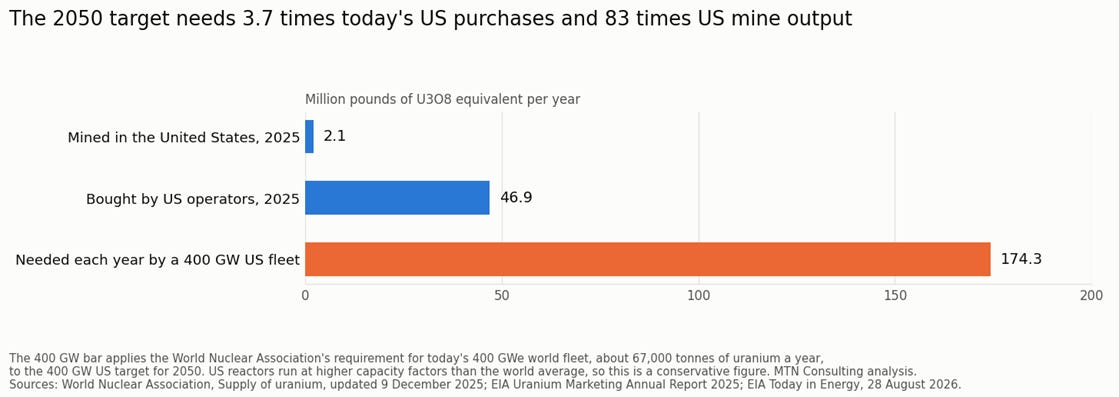
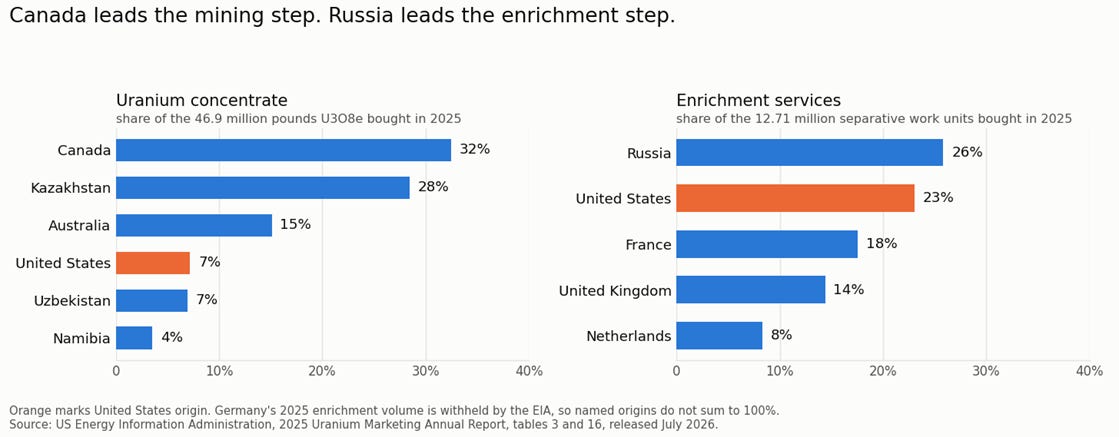
The United States neither mines that much uranium nor owns the plants to process it. Civilian owners and operators bought 46.9 million pounds of concentrate in 2025. Material of US origin accounted for 3.4 million pounds, 7%, and foreign sources covered the other 93%, according to a July 2026 report from the US Energy Information Administration. Canada supplied 15.2 million, 32%, the largest share of any origin, ahead of Kazakhstan at 28% and Australia at 15%. American mines dug up less than even that 3.4 million. Production tripled in 2025 to 2.1 million pounds, the best year since 2017 and 4.5% of what utilities bought. The rest of the US-origin material came out of inventory rather than the ground.
Not one product, but six steps
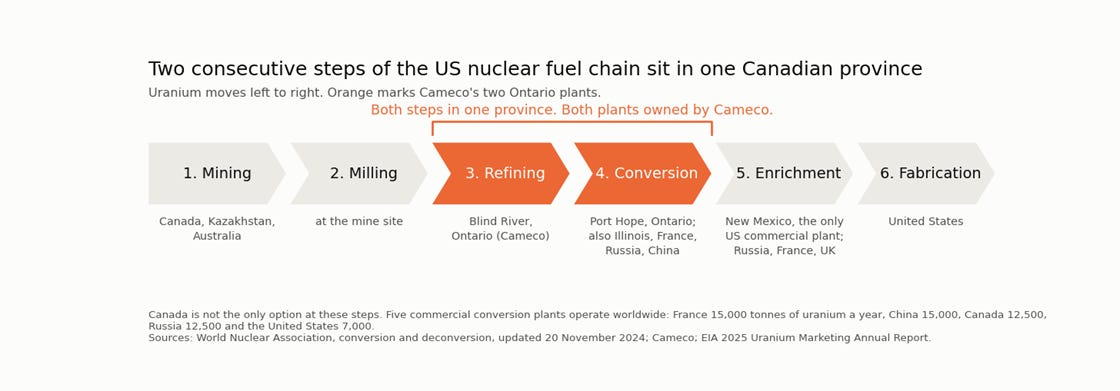
Uranium is not a single product, and that is where the US dependence gets sharper. To become fuel, uranium is mined, milled into concentrate, refined into uranium trioxide, converted into uranium hexafluoride gas, enriched to raise the share of the fissile isotope U-235, then fabricated into fuel assemblies. Each step happens at a different kind of plant, so a country can be strong at one and absent from the next. Canada is not alone at any of them. Five commercial conversion plants operate worldwide, per the World Nuclear Association: France and China at 15,000 tonnes of uranium a year each, Canada and Russia at 12,500, and the United States at 7,000. Two of the three alternatives to Canada are Russia and China.
Canada is strong at two consecutive steps in the middle. Cameco’s Blind River plant is the world’s largest commercial uranium refinery by the company’s own description, and its Port Hope conversion facility takes the output. Both sit in Canada’s Ontario province. The United States has one conversion plant, Metropolis Works in Illinois, restarted in 2023 and expecting more than 10,000 tonnes of uranium hexafluoride this year, and one commercial enrichment plant, Urenco USA at Eunice, New Mexico.
The other clock: Russian enrichment
The 2050 target is decades away. A second deadline is 16 months away, it is written into US law, and it raises US demand for Canadian material.
Enrichment is not sold by weight. It is sold in “separative work units”, a measure of the machine effort needed to raise the U-235 content of a given quantity of uranium. US operators bought 12.71 million of them in 2025. Russia supplied 3.28 million, 26%, more than any other source, per the same EIA report.
Despite broad economic sanctions, the United States continues to purchase enriched uranium from Russia’s state-owned supplier. US purchases of Russian enriched uranium came to $1.2 billion in 2023 and $624 million in 2024, and Rosatom earns roughly $1 billion a year from the trade, per Bellona on 17 March 2025, citing UN Comtrade data. Congress banned these imports in 2024, effective 11 August that year, but President Trump’s Department of Energy has been issuing waivers and the material keeps arriving. No waiver can run past 1 January 2028, per the Nuclear Regulatory Commission, and the prohibition then holds until the law itself expires at the end of 2040.
Replacing Russian enriched product takes more than Western centrifuges. It takes natural uranium and conversion capacity to feed those centrifuges, and both are things Canada sells. Urenco USA’s near-term addition of 700,000 separative work units covers 21% of the Russian volume, per ANS Nuclear Newswire on 6 July 2026. So a US decision to stop buying Russian fuel would rely on Canadian mills and Canadian conversion plants, at the same moment Washington is trying to tariff Canada into a deal.
